Don’t be absurd, Janine
This essay on Peter Fiennes’s En Route first appeared as a Monday Writing Motivation, my free weekly email for writers. Sign up here to get the next one.
Every week I promise myself I’ll carry a notebook, and every week I don’t. Ideas arrive in the shower, on a walk, halfway through someone else’s sentence, and I tell myself that anything that good can’t possibly be forgotten. Then it is.
On Tuesday two ideas occurred to me for future Monday Writing Motivations, but when I woke this morning – it’s Saturday – in order to write, the ideas had fled.

A rainy afternoon in Peter Fiennes’s En Route
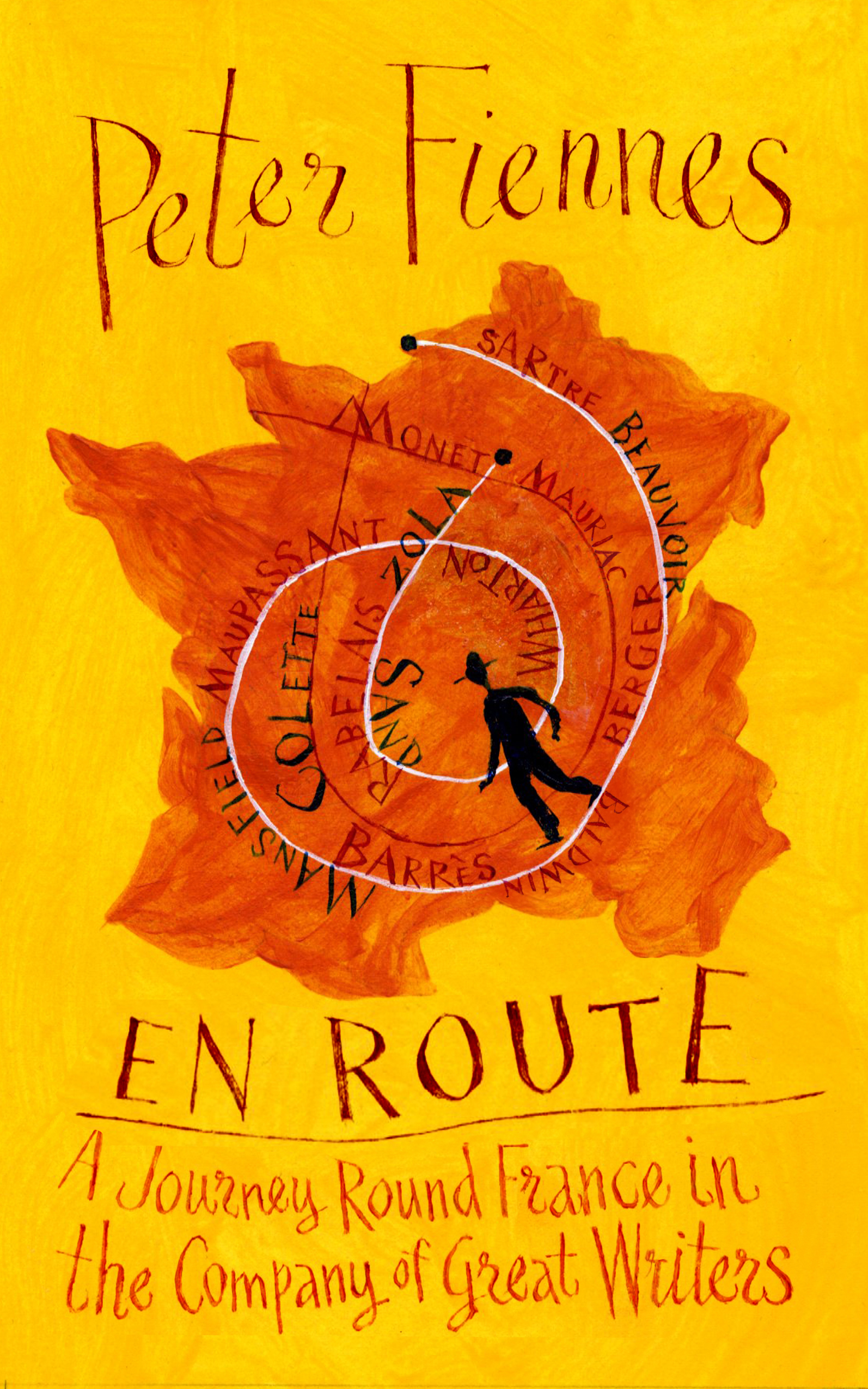
So instead of an idea of my own, I’m offering one that someone else caught on the wing and committed to paper. It comes from Peter Fiennes’s En Route, which I read recently and have been pressing on people ever since. Fiennes is walking to the beach in Le Havre, in what is supposed to be summer.
On the way to the beach, I passed a string of almost-empty brasseries with wide terraces facing the sea, one of them with an elaborately etched, immaculately polished glass windbreak reading “UN ÉTÉ AU HAVRE”. But where is everyone? And what kind of summer was this? I was alone, and I found myself slowing, muffled in the grey and beige light, all soft pastels, wrapped in my raincoat (it was cold), wide concrete paving stones underfoot, concrete apartment buildings to the right, an endless stretch of balconies looking blankly out over the uneasy ocean, chairs and tables set for two (but no one sitting at them), the concrete sky above, now surprisingly low, oozing rain, and the sea to the left, white horses and no horizon, shingle and cement, mud, salt and diesel in the air, and I slowed and stopped entirely, the rain falling hard now; huddled under a covered walkway, and I heard a tearful young English voice calling out from deep inside one of the brasseries, ‘Mummy!’ and an adult laughed and said, ‘Oh don’t be absurd, Janine.’ — Peter Fiennes, En Route: A Journey Round France in the Company of Great Writers (Oneworld)
Start with what he saw. The detail isn’t exhaustive. It’s selected, and nearly all of it reflects absence. The brasseries are almost empty. The tables are laid for two, and nobody’s sitting at them. The balconies look out blankly. The one object that says anything at all is the polished glass windbreak with its etched promise of a summer in Le Havre. Then Fiennes asks outright: Where is everyone? Bear that question in mind; Fiennes will answer it.
A sentence that slows down as you read it
You will have registered Fiennes’s long and meandering sentence. It runs to well over a hundred words, (I love long sentences!) but its length isn’t what matters. What matters is that it does what it describes. Fiennes tells us he found himself slowing, and the sentence slows with him. Clause piles on clause, and as the catalogue grows the verbs quietly retreat, like the tide ebbing. We’re left with nouns and nothing happening: shingle and cement, mud, salt and diesel in the air. By the time he tells us he slowed and stopped entirely, the grammar has already stopped. You feel it grinding to a stop before you’re told about it.
 Then there’s the concrete. First the paving stones, then the apartment buildings, then the sky. By this point the word has come loose from its literal meaning, and a low sky oozing rain reads like wet cement being poured over the town. It would be easy to call this pathetic fallacy, the landscape dressed up in the writer’s mood, but that isn’t quite right. Le Havre was flattened in 1944 and rebuilt almost entirely in reinforced concrete. Fiennes’s gloom hasn’t invented the concrete; it has found it. The mood and the material suit each other. The repetition keeps pressing the point until the reader, too, is standing under a covered walkway, damp and a little dispirited, with no horizon in sight.
And then there’s Janine.
A child’s voice, English and tearful, calls “Mummy!” from deep inside one of the brasseries. An adult laughs: “Oh don’t be absurd, Janine.”
It’s very funny, and it’s tempting to call it a twist. Well, it is – a little quirk to bring the scene to an end. But it’s more than that. Fiennes has been quietly amused all along. Listen to his commentary, fenced in with parentheses: “(it was cold)”, “(but no one sitting at them)”. The dry voice is there from the start. The ending simply turns up the volume.
The ending does three things at once. First, it answers the question he posed at the start: ‘Where iseveryone?’ Everyone is inside, sheltering, and they’re English: he has crossed the Channel only to find the people he left behind. Second, it gives the paragraph’s melancholy a voice. The child’s wail is what the whole long sentence has been feeling without saying. Third, the adult’s reply, brisk and unimpressed, lands directly on the writer. Don’t be absurd. It’s a mild rebuke delivered to Janine but received by Fiennes, and by us, who had been rather enjoying his wistfulness.
What it doesn’t do is cancel anything. The sea is still grey, the tables still empty, the sky still low. The ending doesn’t resolve the mood. It lets us see the mood from outside and smile at it while the rain carries on. That’s the perspective the humour brings.
Which brings me back to my lost ideas. Nobody invents Janine. You couldn’t: the name is too specific and faintly comic, and the adult’s phrasing is too exactly right. Someone heard it on a wet day in Le Havre and wrote it down, along with the smell of diesel and salt and the etched glass. The long sentence, the repeated use of concrete and the perfectly placed punchline are all acts of craft. But craft needs material, and material has to be caught as it flies past.
So I have, once again, decided never to venture out without both a notebook and a reliable pen. Whether I’ll actually use them is another matter.
Richard
Every Monday, a writer’s nudge in your inbox
Every Monday I send out an essay like this one, about a book, a sentence or a problem I’ve been wrestling with in my own writing. It’s short, free and written for people who write. If you’d like it in your inbox, sign up below.