How to Write a Short Story: Key Insights from Joanne Hichens, David Mann and Kamva Majo
All About Writing recently hosted one of our favourite kinds of evenings — an honest, illuminating conversation about the short story, with writers at very different points in their journey.
As Richard Beynon noted in his opening, Joanne Hichens’ work “promoting the short story and encouraging writers to write them has made and continues to make a real considerable impact” — and this evening was a perfect example of that. Joanne was joined by David Mann, multiple award-winning short story writer and art critic, and Kamva Majo, an emerging voice who is already making her mark on the South African literary scene.
Together, they explored what draws writers to the short form, how story ideas are found and developed, the difference between art and craft, and how to navigate rejection, trauma, and the realities of publishing. The conversation was warm, practical, and full of the kind of insight you only get when writers speak candidly about their own experience. Watch the full replay and read the summary below.
Watch the Full Conversation
Read the Stories: Books to Add to Your Collection
One of the best ways to learn how to write a short story is to read great ones. If this webinar has fired you up, here are five books we’d encourage you to get your hands on — each one a testament to the power of the short form.
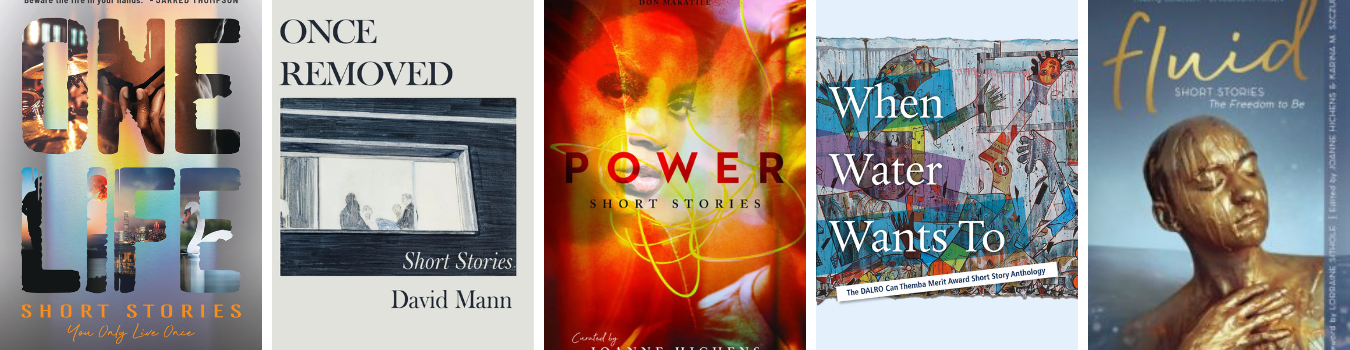
Once Removed by David Mann
David’s debut collection features 13 subtly interlinked short stories set in the South African art world. Precise, intelligent, and quietly devastating, Once Removed won him the Thomas Pringle Award and announced him as one of the most distinctive voices in South African short fiction. Buy directly from Botsotso.
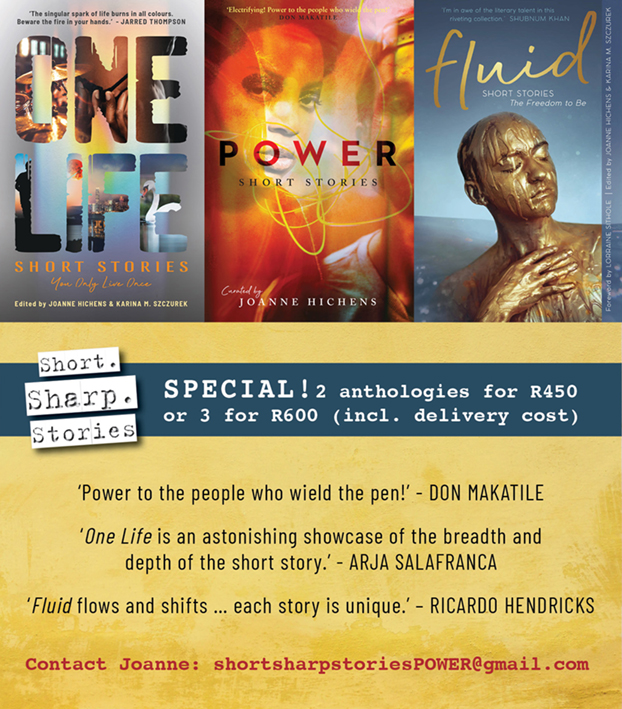
The Short.Sharp.Stories Anthologies: Power, One Life, and Fluid
Joanne Hichens is the driving force behind the Short.Sharp.Stories anthologies which have been championing South African short fiction for years. Power, described as “electrifying” by Don Makatile, includes Kamva Majo’s debut published story. One Life has been called “an astonishing showcase of the breadth and depth of the short story” by Arja Salafranca. And Fluid: The Freedom to Be, drew praise for its range and originality.
There’s a special offer running now: pick up any 2 anthologies for R450, or all 3 for R600 — including delivery. To order, contact Joanne directly at shortsharpstoriesPOWER@gmail.com.
When Water Wants To — the DALRO Can Themba Merit Award short story collection
Kamva also features in this anthology published by Wits University Press. Her story A Mortician’s Instinct is one of ten in a collection that ranges, as the publishers describe it, from the deeply personal to the wildly allegorical, playing with genre conventions and inhabiting a multitude of perspectives and unruly voices. It’s a remarkable showcase of emerging South African short fiction, and a brilliant example of exactly what Kamva spoke about in the webinar: writing from obsession, from fear, from the things that press at you until you have no choice but to put them on the page. Available from Wits University Press and good bookstores.
Reading widely in the short form isn’t just pleasurable — it’s one of the most effective short story writing tips we know. As Joanne, David and Kamva all made clear in the webinar, the writers who read are the writers who grow.
Want to take your short story craft further?
-
Join our two-evening short story workshop with Joanne Hichens — details coming soon. Email Trish to join the waitlist
-
Explore our Creative Writing Course which will help you hone your writing craft
-
Submit to the next Short.Sharp.Stories anthology: Home Cooked Recipes of Triumph and Disaster. Follow the Short.Sharp.Stories Facebook page for submission details
Notes from the short story webinar
What makes the short story such a powerful and enduring form
If you’ve ever wondered how to write a short story that truly lands — one that grips a reader from the first line and stays with them long after the last — you’re not alone. It’s one of the questions writers at every stage ask most often. What makes the short story such an enduring and powerful form? And how do writers actually find their ideas, develop their craft, and keep going through the difficult moments?
In a wide-ranging webinar hosted by All About Writing, short story editor and teacher Joanne Hichens sat down with two writers who represent, as she put it, “two different extremes”: David Mann, a multiple award-winning writer whose debut collection Once Removed has been celebrated across the South African literary world, and Kamva Majo, an emerging writer whose story in the Short Sharp Stories anthology Power announced her as a significant voice to watch.
The result was one of the most honest and practically useful conversations we’ve had about short fiction. Whether you’re writing your first short story or your fiftieth, here are the key insights.
Why write short stories?
Richard Beynon opened the evening with an anecdote about George Saunders — Booker Prize winner and author of A Swim in a Pond in the Rain — who spent a decade analysing what distinguishes the short story from the novel. His conclusion? A short story is short. In every other respect, it’s just like a novel.
Both David and Kamva spoke about why the form drew them in. For David, it’s about the era we’re living in. Short form is how we engage with the world — in bite-sized vignettes, in the kind of thinking and reading and viewing that doesn’t ask for months of sustained commitment. But beyond that, he described the short story as a site for play and experimentation, “failure with relatively low stakes” — and one that remains always in a state of process. A story goes into the world, meets readers, receives feedback, and gets reworked. It’s collaborative and alive.
Kamva’s entry point was more personal. She had always written short stories at school, but never saw it as properly creative. When she tried to return to writing for joy rather than marks, the short form was her way back in — not because it’s easier (she was clear that it isn’t), but because it gets to the result faster. Getting into the action quickly, seeing something completed, gave her the confidence to keep going.
Where do short story ideas come from?
Joanne was direct about this: writers don’t need to pluck ideas from thin air. The pressure to find something entirely original is often a form of procrastination. “Nothing is new under the sun,” said Kamva, “but the main purpose is to let people who have similar stories or life experiences find resonance in yours — and know that they are not alone.”
For Kamva, the trigger is obsession. She described the story behind The Mortician’s Instinct — she became fascinated by morticians, watching video after video, disappointed to find they were essentially ordinary people, but holding onto the darker image she had in her mind and writing from there. A second story emerged from her desire to confront her own fear of schizophrenia, rooted in a childhood experience with a family member. She read her abnormal psychology textbook, researched different forms of the condition, and built a character from that exploration. The story wrote itself from the obsession.
David works as an art critic, and almost all his fiction returns to that world. But where journalism and criticism are fixed — bound to formats, to certainties — fiction becomes an open, generative space for all the questions, predicaments and frustrations that don’t fit anywhere else. His Thomas Pringle Award-winning story Meaningful Contributions came from frustration with arts funding in South Africa: the impossible hoops, the abstract goals, the fundamental disconnect between what funders ask for and what creative work actually requires. The story became a comedic vehicle for that frustration — and ultimately won him a prize.
The practical advice from both? Find the thing that is pressing at you. A short story needs that hunger — that urgency — and readers will sense it, even if they can’t name it.
Art and craft: What’s the difference?
Joanne described the art of a story as its heart — the passion for the idea, the authentic voice, the trust in one’s own writing self. The craft is everything that can be learned: setting, point of view, plot, structure, character development.
David added something important: writing is larger than what happens on the page. It’s the ambient, secondary, passive process — turning a story over in your mind while you’re out for a run, thinking about how your character would react in a traffic jam. Seamus Heaney’s poem Digging informed his thinking here: writing as unearthing, as excavation, as making sense of the world through searching.
For Kamva, the art is the process — and the process is your life. The craft is sitting down and making something of it. She described often not realising that a neighbour, a moment, a fear would eventually find its way into a story. You’re living the material before you know it’s material.
Short story writing tips: Let character drive everything
Joanne offered a clear piece of craft advice that applies as much to short stories as to novels: stories are driven by character. In short fiction, there isn’t time for backstory — you meet the protagonist in the opening paragraph, often in the first line, and almost always at a seminal moment in their lives.
She quoted Kurt Vonnegut’s first rule of writing: make your characters want something right away, even if it’s only a glass of water. That want — that desire or need — is what drives the story forward and prevents it from becoming merely anecdotal. The character must be changed by the end. Something must shift.
George Saunders put it this way: what makes a piece of writing a story is that something happens within it that changes the character forever. We tell a story that starts at one time and ends at another in order to frame that moment of change.
Writing through trauma: The third-person distance
One of the most moving exchanges in the webinar came when Bonnie asked how to get the words of a painful experience onto the page when they seem to stick and refuse to come.
Joanne spoke from personal experience — writing about her husband’s death after he had a fatal heart attack. Her advice: just keep physically putting words on the page, not as literature at first, but simply as a record. Allow the tears to come. And make sure there is someone — a friend, a therapist — who can support you through the process.
Kamva offered a practical technique: start with your journal, where the words belong only to you. Get used to seeing the experience outside of your own mind. And then, when you’re ready to move it into a story, try writing in third person rather than first. That distance — the shift from I to she or he or they — can make the writing feel less overwhelming, less like it is you talking, and give you the creative freedom to shape the material rather than simply reliving it.
How to get a short story published
Both David and Kamva had been turned down by Short Sharp Stories before they were accepted. Kamva’s message was simple: start, and limit your expectations. The action of writing — submitting, being turned away, writing again — is what gets you from where you are to where you want to be. There’s no shortcut, and waiting for a profound piece of advice is just another form of procrastination. Just write.
David’s advice for writers further along their journey: say yes to every opportunity, even the tiny ones — the literary journal with 50 followers, the call for submissions that might be read by very few people. The ecosystem is small, but the community is wonderful. And when you receive feedback with a rejection, treat it as gold.
He also made a point worth noting: stop valorising the big publishers. In South Africa, independent publishers are the ones championing the short form and experimental work. They’re the ones willing to take a gamble on debut authors, on strange and beautiful collections. Support them. Submit to them. Buy your books from them.
Social media and copyright
One practical question from the chat: if you publish a short story on social media, does it preclude you from submitting to traditional publishers? The short answer is: tread carefully. Frank, a participant, noted correctly that most competitions and many publications explicitly exclude previously published work — including anything shared online.
David’s perspective: use social media as a testing ground for ideas, not your best work. Post fragments, early thoughts, first-draft experiments. Fold the feedback back in. Don’t give away your finished stories. And keep writing, revising, always reworking — because a short story, in his view, is always in a state of becoming.
 The last word
Joanne closed the evening with a quote from Neil Gaiman: “A short story is the ultimate close-up magic trick. A couple of thousand words to take you around the universe, or break your heart.”
The art is the voice, the passion, the spark that lights within you. The craft is sitting down — on your own, in front of a page or a screen — and doing the work. Research, first draft, revision, editing. All of it.
If this conversation has stirred something in you, don’t wait. These short story writing tips are only useful if you put them to work. Find the pressing thing. Write towards it.

Connect with Joanne and Merle
If you watch the webinar or read this guide, we’re confident you’ll be inspired to explore the memoirs that emerged from this coming together of courage and craft. Joanne Hichens’ Death and the After Parties and Merle Levin’s The World According to Merle are excellent examples of what happens when writers give themselves permission to tell their truth—and trust that their stories matter to others walking similar paths.
Joanne: Website, Short Sharp Stories, Instagram, Facebook and Facebook Author Page
Merle: Website, Instagram and Facebook
Ready to Make 2026 Your Best Writing Year?
Whether you’re just starting your writing journey or working on your next manuscript, All About Writing offers the support and guidance you need to achieve your goals.
Start every week with writerly inspiration by signing up for Richard’s Monday Writing Motivations.
Creative Writing Course – Our comprehensive 10-week live course (starting 22nd January) takes you from the fundamentals of storytelling through to crafting compelling narratives. You’ll learn essential skills in character development, plot structure, dialogue, and revision – all whilst receiving feedback on your work and connecting with fellow writers. Sign up here
One-to-One Mentoring – Working on a novel, memoir, or larger project? Our experienced mentors provide personalised guidance tailored to your specific manuscript and goals. Regular sessions help you maintain momentum, work through challenges, and develop your craft whilst bringing your project to completion. More information here
Writers’ Circle – Join our supportive monthly community where writers share work, receive constructive feedback, and benefit from the collective wisdom of the group. It’s the accountability and encouragement many writers need to keep showing up at the page. Join here
Writing Retreats – Immerse yourself in your writing whilst exploring inspiring locations. Join us in the tranquil Karoo at our Barrydale retreat, experience the charm of the English countryside in Stow-on-the-Wold, or find creative inspiration in the romantic canals and literary history of Venice. These retreats combine dedicated writing time, expert workshops, and the opportunity to connect with fellow writers in beautiful, distraction-free settings. There’s something transformative about stepping away from daily life to focus entirely on your craft.
Free Monthly Webinars – Don’t miss our monthly webinars where we explore essential writing topics, answer your questions, and build a community of committed writers.
Whatever stage you’re at in your writing journey, the key is to start now. Make those writing appointments, focus on one project, and surround yourself with a community that understands the challenges and celebrates the victories. Your story deserves to be written—and we’re here to help you do exactly that.
If you’re not sure exactly what’s right for you, why not test the waters with our free Power of Writing Course or email Trish to discuss your writing project and how we can best help you achieve your goals.