Humour, Rejection and Redefining Success: Key Insights from Bestselling Author Sally Andrew
All About Writing has just hosted a joyful, funny and often moving conversation with bestselling author Sally Andrew – creator of the much-loved Tannie Maria Mysteries – to talk about where Tannie Maria came from, how humour grows out of character rather than plot, how to weave weighty themes into a cozy mystery without losing the fun, and what Sally has learned about the real meaning of success.
It was, as always, a warm and collaborative exchange, shaped as much by the questions and stories shared by attendees in the chat as by our own. Watch the full replay below, then read on for a detailed recap of everything Sally shared.
Watch the Sally Andrew Webinar Replay:
Humour, Rejection and Redefining Success: Key Insights from Bestselling Author Sally Andrew
Sally’s thought’s on the theme of success for writers
Success comes through the willingness to repeatedly fail and learn from it. There’s no recipe for success, and there is: no recipe, because each day you sit down to write, you’re stepping off an abyss; a recipe, because we’re touched by the gods as creators, connecting to the chance to make something fresh with our hands, our brains, our lives. Success is learning to step into that stream and become a co-creator.
One of the biggest steps for me was dealing with envy. There was a writer I knew from school who’d written books and won an award, and I felt envious. I sat with it and thought, ‘This envy is showing me what I really want.’ That’s such a gift. It let me shift from envy to inspiration: if they can do it, I can do it.
The joy is this: to be inspired, and to enjoy the deliciousness of creating. Each of us is unique – we could write the same story and it would come out completely different, because we’re each unique souls who love to create. That appreciation is the central thing in success.
Yes, it’s amazing to have an agent, get published, earn a living from your work. But those are secondary – I know people who have all of that and aren’t happy. They haven’t found that overlapping point, as Mandela quoted, of where your greatest joy meets the cry of the world. We love to do what we love, but we’re also interconnected humans who want to offer something that helps others. Finding that overlap takes real self-respect and self-love – not ego, but appreciation of the gift.
It’s such a blessing to be a writer, whether you make a living from it or just write in your own diary. The critical voices will exist, but they need to fall back, so the creator and the editor in you can both play – and your editor must be a coach, not a critic.
Success is also just appreciating your life every day. When you fail, there’s always something to learn, and always a choice. So success is reclaiming your choices, reclaiming your power, celebrating who you are, enjoying the bliss of writing – and getting your bum on the seat. That’s what I’ve been failing at lately. You can have all the rest, but unless you put your bum on the seat and put in the hours, none of it counts. Just do it.
That’s what I’ll look to in future when I feel lost – and for my past self, to help her catch up to the present.
***
How do you build a character so beloved that she wins international cooking awards despite not existing? And how do you keep her fresh across five books, weave in weighty themes like environmental poaching and PTSD, and still make readers laugh out loud?
Meet Tannie Maria — and Her Creator
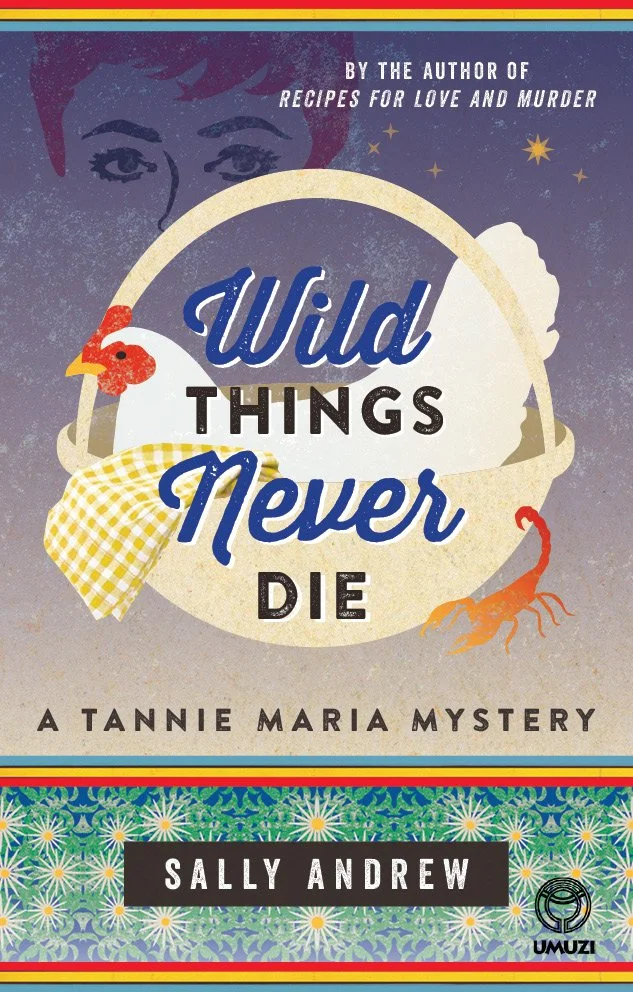 Sally opened the evening reading from her brand-new fifth novel, Wild Things Never Die, in which Tannie Maria and her fiancé, Detective Henk Kannemeyer, go undercover at a luxury game lodge to help save the vetplantjies from poachers — all while Tannie Maria wrestles with her own fear of the dark, and her hen, Henrietta, recovers from PTSD of her own. It’s classic Tannie Maria: recipes, love, murder, and a serious theme handled with a light touch.
Where Real Characters Come From
Asked how much of herself is in Tannie Maria, Sally was clear: she deliberately built a character different from herself — “but I have now got older and plumper, so I sort of feel I’m sneaking up to becoming more like her.”
Tannie Maria wasn’t even Afrikaans in the way she ended up. Sally originally wrote her as more fully Afrikaans, until a beta reader pointed out she felt ‘too crazy’ for that — so Sally gave her an English father, whose backstory eventually grew into a major plotline in book three. It’s a good reminder that character development doesn’t stop once a draft is finished — sometimes it keeps evolving for books.
The Secret to Real Humour: Character, Not Jokes
Tannie Maria’s not absurd. We can believe in her, and the humour comes from the close observation of this character and how she would behave.
Sally agreed that Tannie Maria is just her being herself.
“What makes me stop reading or carry on reading a book is when I care about the character… they’ve got to be interesting and they’ve got to be flawed.”
Big Themes, Light Touch
Every Tannie Maria book carries a serious undercurrent — fracking, corruption, PTSD, eating disorders, and in the new book, environmental poaching — but Sally is adamant that theme should never overwhelm story. She won’t finish a book until she’s found a realistic solution to the issue at its heart: “I couldn’t write the book until I could make up possible real solutions, or else it’s too depressing for me.”
The emotional arc matters most to her – in this book, choosing love over fear and connection over control – but it’s always balanced by comedy. “I love it if I can reread my book and in the middle of some scary, near-murder scene, there’s just something going on with a hen and a bra around her neck, and I can laugh out loud.”
Keeping a Five-Book Series Fresh
Rather than plotting the whole series in advance, Sally lets Tannie Maria’s growth track her own. “I always link what she’s working through to something I’m working through.”
Freshness, for Sally, doesn’t mean reinventing the wheel each time. She likes readers to return to the same stoep, the same mountains, the same birdsong — “the poetry of repetition” — just seen from a slightly different angle each time.
Can You Base a Character on Someone You Know?
One of the evening’s most useful exchanges came from an audience question: Marzanne, whose debut novel is being published next year, asked how to handle people who might recognise themselves in her fiction. Sally’s advice was blunt and freeing: put a line at the front of the book stating that all characters are fictional, then let it go. “It really is their problem… you’re entitled to base things on people” — with one important caveat: if enough people at a dinner party could identify the real person behind a character, that’s a legal risk, not just an awkward conversation. Change their appearance, their setting, something – and otherwise, stop worrying what other people think. “It’s easier said than done, but that’s the thing to focus on.”
Sally also shared her own approach: her characters are invented, but she’s occasionally discovered – after the fact – that a name or detail she made up matches something real (an invented policeman’s surname turned out to belong to an actual Ladismith constable). She’s learned to research roles and settings thoroughly, then build a character who is clearly, deliberately different from anyone real.
Writing Place Without Overwriting It
Living immersed in the Klein Karoo, Sally said, means she can bring in a single vivid detail rather than over-explain – a bird call, the shape of a mountain – and let it be enough. It’s the areas she’s had to research, rather than lived, that she’s tempted to overwrite, “to prove that I know it.” Good research, like a good petticoat, should support the story without ever being seen.
A Very South African Story, Read Around the World
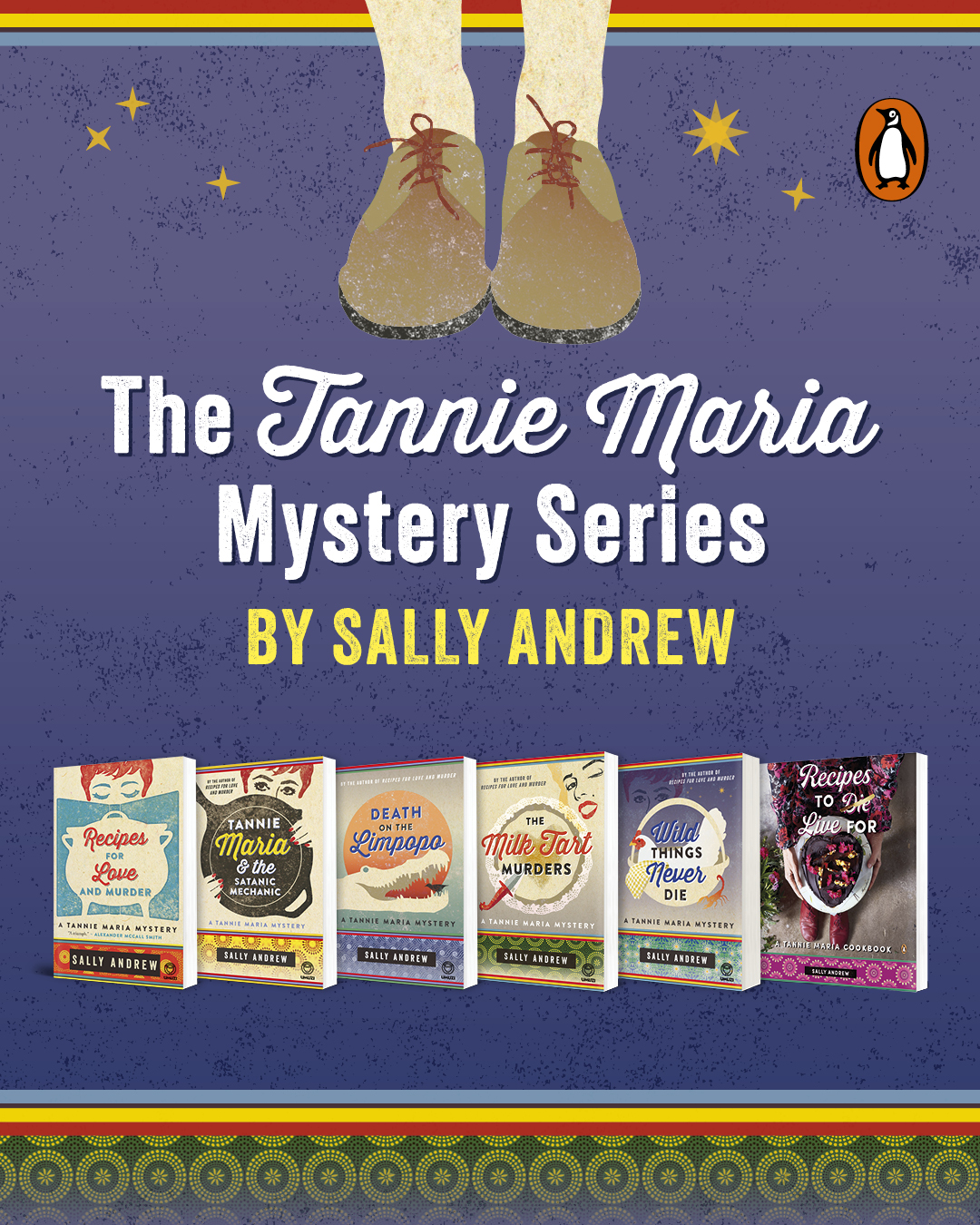 Despite being deeply rooted in the Klein Karoo, the Tannie Maria books have been translated into 14 languages. Sally’s explanation: specificity, not generality, is what travels. Readers don’t need to know what a bokmakierie is if the next line describes “the shrike sang out” — and a light-touch glossary handles the rest. What connects internationally, she said, are the archetypal threads: food, small-town life, love, nature. “People love to travel for the price of a book instead of a plane ticket.”
On Rejection: Keep Going
Sally estimates she’s been rejected roughly 200 times across her writing career — including wildly contradictory feedback on her very first manuscript, Recipes for Love and Murder. One well-known author told her, bluntly, that she “hadn’t got it.” Weeks later, a different editor told her the opposite: that she had something special. That second opinion carried her through to writing the sequel — and finding an agent. Her advice to her past self, and to anyone starting out: “Keep going. You’re going to make a living out of writing… and keep believing in the possibility of that.”
The Last Word
Sally closed the evening by reminding everyone that writing – whatever stage you’re at – is worth savouring for its own sake: “It’s such a blessing to be a writer, it’s such a blessing to enjoy it, whether you make a living of it or you just write in your own diary.”
Want more Tannie Maria?
We’re sure this conversation has left you wanting more Tannie Maria – so if you haven’t already read it, grab a copy of Wild Things Never Die, Sally’s brand-new fifth novel, or start at the very beginning of the series with Recipes for Love and Murder.
Connect with Sally Andrew
www.sallyandrew.com
Instagram: @sallyandrewkaroo
Facebook: Sally Andrew
Our Creative Writing Course is open for enrolment
If Sally’s story left you itching to write that book, our flagship Creative Writing Course covers everything we wish we’d known when we started out. We’ve opened up bookings for January 2027 and the course is on an early bird special at the moment. Spaces are limited so that everyone gets proper personal attention — so if you’re keen, don’t wait too long. The course runs live on Zoom in the evenings for ten weeks. Book your place here.

Connect with Joanne and Merle
If you watch the webinar or read this guide, we’re confident you’ll be inspired to explore the memoirs that emerged from this coming together of courage and craft. Joanne Hichens’ Death and the After Parties and Merle Levin’s The World According to Merle are excellent examples of what happens when writers give themselves permission to tell their truth—and trust that their stories matter to others walking similar paths.
Joanne: Website, Short Sharp Stories, Instagram, Facebook and Facebook Author Page
Merle: Website, Instagram and Facebook
Ready to Make 2026 Your Best Writing Year?
Whether you’re just starting your writing journey or working on your next manuscript, All About Writing offers the support and guidance you need to achieve your goals.
Start every week with writerly inspiration by signing up for Richard’s Monday Writing Motivations.
Creative Writing Course – Our comprehensive 10-week live course (starting 22nd January) takes you from the fundamentals of storytelling through to crafting compelling narratives. You’ll learn essential skills in character development, plot structure, dialogue, and revision – all whilst receiving feedback on your work and connecting with fellow writers. Sign up here
One-to-One Mentoring – Working on a novel, memoir, or larger project? Our experienced mentors provide personalised guidance tailored to your specific manuscript and goals. Regular sessions help you maintain momentum, work through challenges, and develop your craft whilst bringing your project to completion. More information here
Writers’ Circle – Join our supportive monthly community where writers share work, receive constructive feedback, and benefit from the collective wisdom of the group. It’s the accountability and encouragement many writers need to keep showing up at the page. Join here
Writing Retreats – Immerse yourself in your writing whilst exploring inspiring locations. Join us in the tranquil Karoo at our Barrydale retreat, experience the charm of the English countryside in Stow-on-the-Wold, or find creative inspiration in the romantic canals and literary history of Venice. These retreats combine dedicated writing time, expert workshops, and the opportunity to connect with fellow writers in beautiful, distraction-free settings. There’s something transformative about stepping away from daily life to focus entirely on your craft.
Free Monthly Webinars – Don’t miss our monthly webinars where we explore essential writing topics, answer your questions, and build a community of committed writers.
Whatever stage you’re at in your writing journey, the key is to start now. Make those writing appointments, focus on one project, and surround yourself with a community that understands the challenges and celebrates the victories. Your story deserves to be written—and we’re here to help you do exactly that.
If you’re not sure exactly what’s right for you, why not test the waters with our free Power of Writing Course or email Trish to discuss your writing project and how we can best help you achieve your goals.